

Introduction
Every practice owner I've talked to has a version of the same story. The schedule is full, patients are happy, the care is good, and yet the money coming in never quite matches the work going out. Claims sit unpaid. Denials pile up in a folder nobody has time to open. The front desk is answering phones, checking eligibility and chasing insurance companies all at once.
At some point, most practices start looking at outsourcing their billing. That's usually a smart move. But here's the catch: a bad billing partner can leave you worse off than doing it yourself. The wrong company will cost you money quietly, month after month, in ways that are hard to spot until you look closely at your numbers.
So how do you choose the right medical billing company for your practice? This guide walks you through exactly what to look for, what to ask, and what should make you walk away. Whether you run a solo clinic or a multi-provider group, these are the same questions we'd want answered if we were in your shoes.

Why Choosing the Right Billing Partner Matters
Your billing company is not just a vendor. It sits between your practice and almost every dollar you earn. When it works well, claims go out clean, payments arrive on time, and you rarely think about it. When it doesn't, the damage shows up slowly: rising denial rates, aging accounts receivable, frustrated patients getting confusing statements, and compliance risks you didn't know you had.
A strong medical billing company should do three things for you:
- Collect more of what you've earned by reducing denials and following up on every unpaid claim.
- Get you paid faster by submitting clean claims quickly and working rejections the same week.
- Give you back time so your staff can focus on patients instead of payer phone trees.
If a company can't clearly show how it will do all three, keep looking.
Step 1: Understand Your Own Practice First
Before you compare billing companies, get clear on what you actually need. It's much easier to judge a vendor when you know your own numbers and pain points.
Start by answering these questions:
- What's your specialty? Cardiology, behavioral health, physical therapy and urgent care all have very different coding rules and payer quirks.
- What's your monthly claim volume? A solo provider and a 15-provider group need different levels of support.
- Which payers do you work with most? Medicare, Medicaid, commercial plans and workers' comp each come with their own headaches.
- Where is revenue leaking today? High denials, slow payments, missed charges, or uncollected patient balances?
- What do you want to keep in-house? Some practices outsource everything; others keep front-desk tasks like eligibility checks and scheduling.
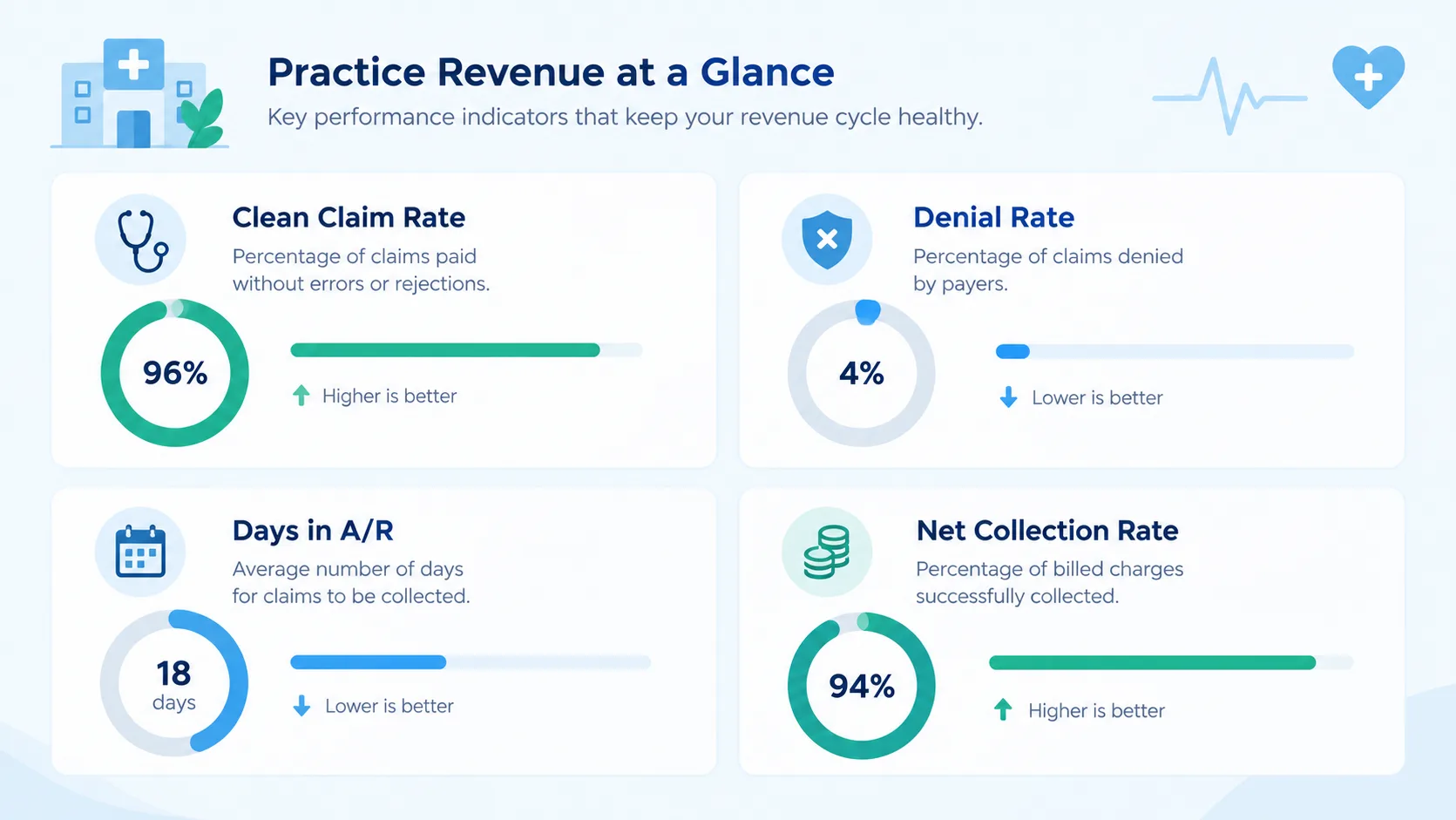
Pull your last three to six months of reports if you can. Note your denial rate, days in accounts receivable (A/R) and net collection rate. These become your baseline. Later, you'll use them to hold your new billing partner accountable.

Step 2: Evaluate the Factors That Really Matter
Once you know what you need, compare billing companies on these core areas. Skip the glossy sales decks and focus on proof.
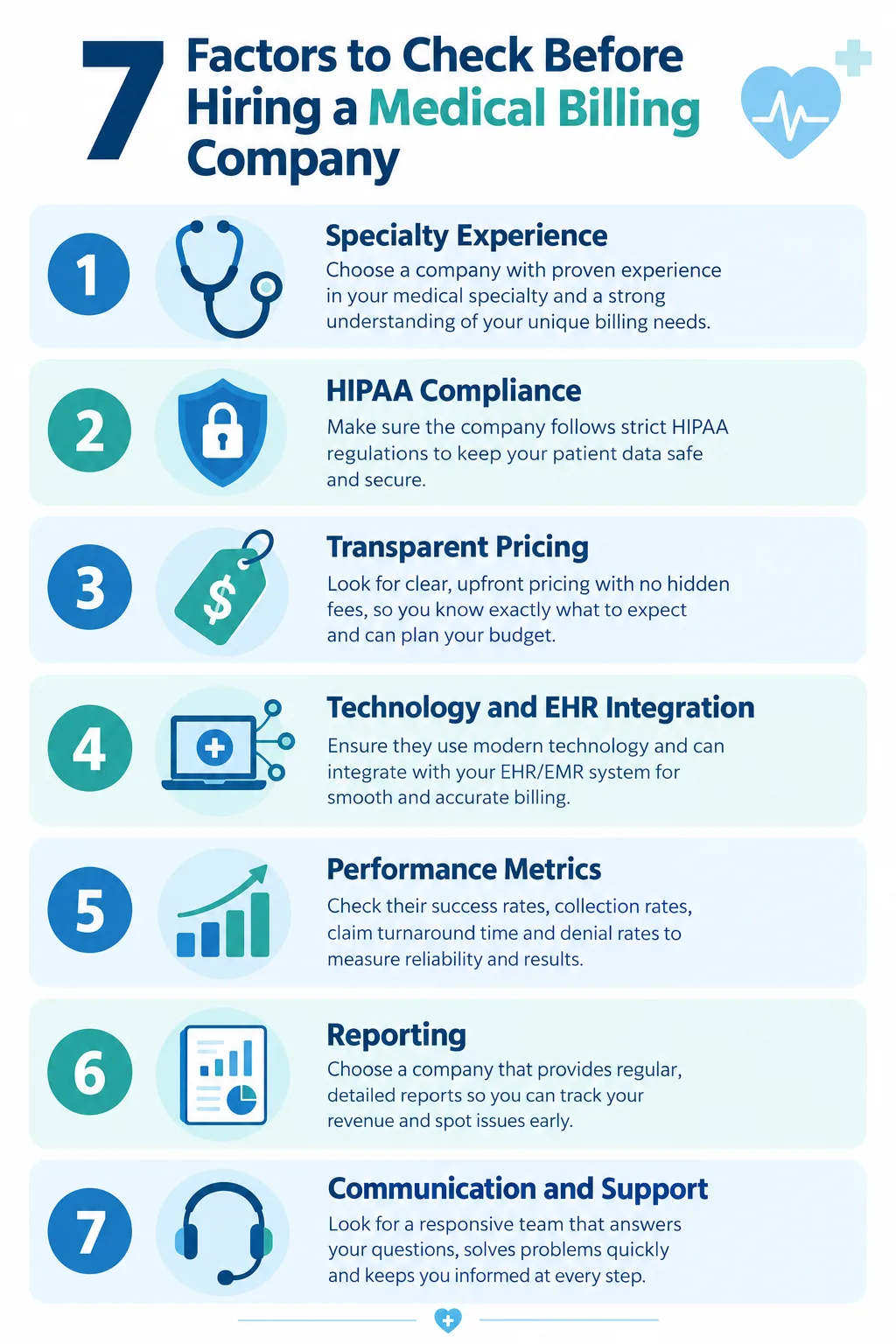
1. Specialty Experience
General billing knowledge isn't enough. Ask how many practices in your specialty the company currently serves. A team that already knows your common CPT codes, modifiers and payer rules will make fewer mistakes from day one. Ask for a reference from a practice similar to yours, and actually call them.
2. HIPAA Compliance and Data Security
Your billing company will handle protected health information every single day. Make sure they:
- Sign a Business Associate Agreement (BAA) without hesitation
- Use encrypted systems and secure, role-based access
- Train their staff on HIPAA regularly
- Have a clear plan for data breaches and backups
If a company gets vague when you ask about security, that's your answer.
3. Transparent Pricing
Most medical billing companies charge in one of three ways:
|
Pricing model |
How it works |
Best for |
|---|---|---|
|
Percentage of collections |
A set percentage of what they actually collect, commonly in the mid single digits |
Most practices; the company is motivated to collect more |
|
Flat fee per claim |
A fixed amount for each claim submitted |
High-volume practices with simple, predictable claims |
|
Fixed monthly fee |
One set price each month regardless of volume |
Practices with steady volume that want a predictable budget |
The percentage model is the most common, and for good reason: the company only does well when you do. Whatever the model, ask exactly what's included. Watch for extra charges for setup, patient statements, credentialing, reporting or software access. A low headline rate can hide a lot of add-ons.
4. Technology and EHR Integration
The billing company should work smoothly with the EHR or practice management system you already use. You shouldn't have to switch software just to fit their process. Ask whether they offer claim scrubbing before submission, electronic remittance, automated eligibility checks, and a client portal where you can see your numbers anytime.
5. Proven Performance Metrics
This is where good companies separate themselves. Ask for their actual numbers, not promises:
- Clean claim rate: strong companies aim for 95% or higher
- Denial rate: ideally well under 10%, with a clear process for appeals
- Days in A/R: many healthy practices keep this under 30 to 40 days
- Net collection rate: top performers commonly reach 95% or more
If they can't share these figures, or won't commit to targets in writing, be cautious.
6. Reporting and Transparency
You should never wonder where your money is. A good partner sends clear monthly reports covering collections, denials by reason, aging A/R and payer performance. Better still, they sit down with you to explain what the numbers mean and what they're doing about problem areas.
7. Communication and Support
Ask who your day-to-day contact will be. Will you have a dedicated account manager, or will you be calling a general support line? How quickly do they respond to emails? Billing problems rarely wait, so responsiveness matters more than most practices expect.
Step 3: Ask the Right Questions Before You Sign
A short call with the right questions will tell you more than any brochure. Bring this list to every vendor conversation:
- How many clients do you currently serve in my specialty?
- Are your billers and coders certified (for example, CPC or CCS)?
- Are your billing staff in-house, or do you subcontract the work?
- What is your average clean claim rate, denial rate and days in A/R?
- How do you handle denied claims, and how fast do you appeal them?
- Do you follow up on every unpaid claim, including small balances?
- What does your onboarding and transition process look like, and how long does it take?
- What reports will I receive, and how often?
- Who owns the data if we part ways, and how do I get it back?
- What are the contract length and cancellation terms?
Pay attention not just to the answers, but to how they answer. Confident, specific responses are a good sign. Dodging or vague generalities are not.
Red Flags to Watch Out For
Some warning signs show up early if you know where to look:
- Promises that sound too good, like guaranteed 100% collections or zero denials
- Long, rigid contracts with heavy penalties for leaving
- Unclear pricing or reluctance to put all fees in writing
- No references from practices like yours
- Ignoring small claims, which can add up to serious lost revenue
- Slow or inconsistent communication during the sales process (it rarely gets better after you sign)
- No clear answer on data ownership if you decide to leave
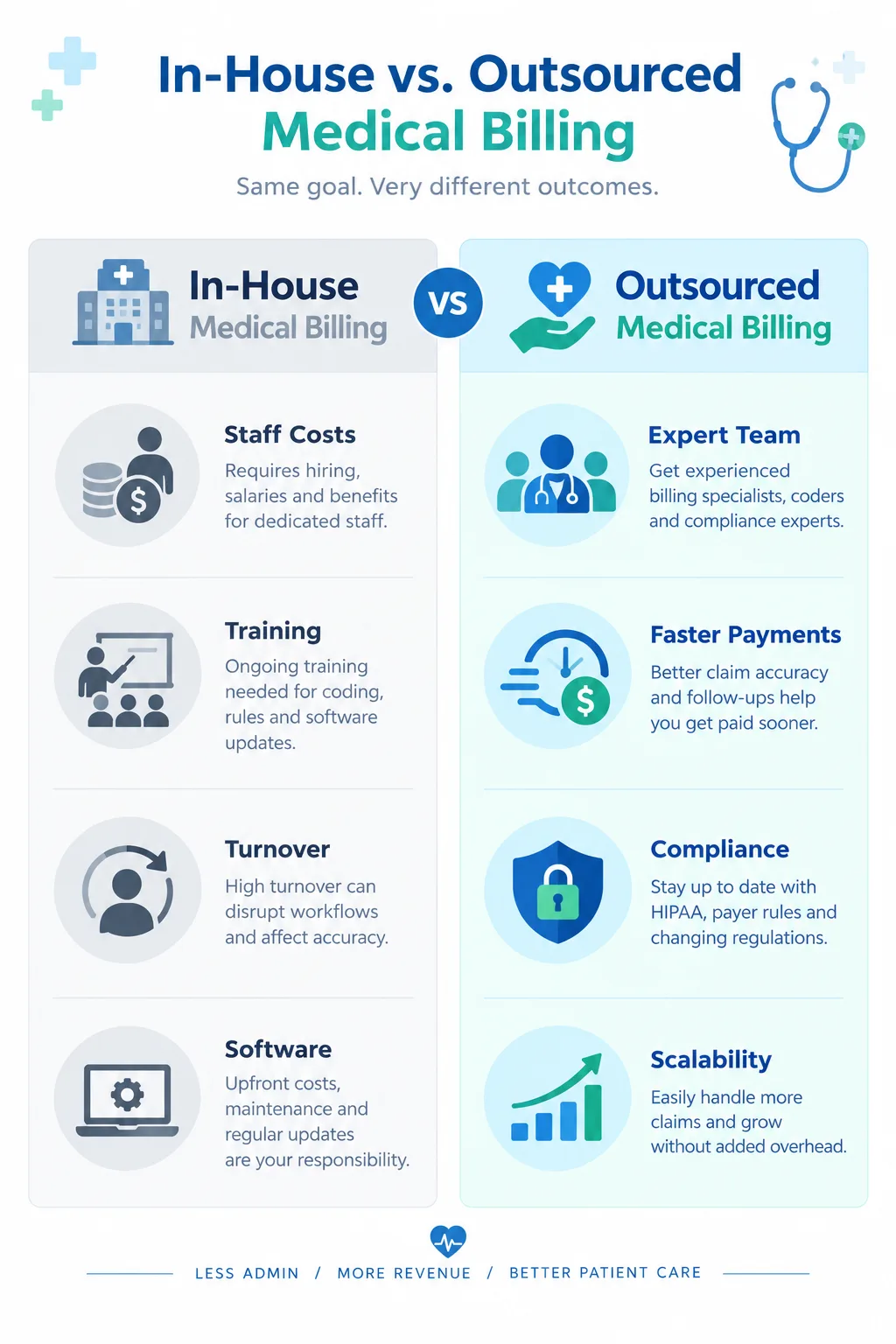
In-House Billing vs. Outsourcing: A Quick Comparison
Still weighing whether to outsource at all? Here's how the two options usually stack up:
|
Factor |
In-house billing |
Outsourced billing company |
|---|---|---|
|
Cost |
Salaries, benefits, training, software and turnover |
Usually a percentage of collections or a set fee |
|
Expertise |
Depends on one or two staff members |
A full team of trained billers and coders |
|
Staff turnover risk |
High; one resignation can stall cash flow |
Low; the company covers absences |
|
Payer rule updates |
Your staff must keep up on their own |
Handled as part of the service |
|
Control |
Direct, day-to-day oversight |
Shared, through reports and a client portal |
|
Scalability |
Hiring needed as you grow |
Scales with your claim volume |
For many small and mid-sized practices, outsourcing ends up cheaper and more reliable once you add up the hidden costs of running billing in-house.
Final Thoughts: Choose a Partner, Not Just a Provider
Choosing a medical billing company is one of the most important business decisions your practice will make. The right partner understands your specialty, protects your patients' data, charges fairly, and shows you real results every month. The wrong one costs you money you may never even notice was missing.
Take your time. Know your numbers before you start. Ask hard questions, check references, and read the contract carefully. Most of all, choose a company that treats your revenue like it matters, because it does.
Ready to Find the Right Billing Partner?
At Billerfirms, we help healthcare practices find and work with medical billing companies that actually fit their specialty, size and goals. Whether you're outsourcing for the first time or replacing a partner that isn't delivering, we make the process simpler and more transparent.
Get in touch with Billerfirms today and take the guesswork out of choosing your medical billing company.
Looking for a medical billing partner?
Compare vetted billing companies by specialty and state, or let us match you with the best fit, free.


